

C# Switch - Case statement is almost same as the if -- else statement.
Let us understand C# Switch - Case with the below example.
| Roll Number | Name |
|---|---|
| 1 | Ronald |
| 2 | John |
| 3 | Murali |
| 4 | Satish |
| 5 | Debasish |
Now, that you are an expert in if --- else. You wrote the program using if --- else.
public class MyApplication
{
    public static void Main(string[] args)
    {
        int rollNumber = 2;

		if (rollNumber == 1)
		{
			System.Console.WriteLine("Ronald");
		}
		else if (rollNumber == 2)
		{
			System.Console.WriteLine("John");
		}
		else if (rollNumber == 3)
		{
			System.Console.WriteLine("Murali");
		}
		else if (rollNumber == 4)
		{
			System.Console.WriteLine("Satish");
		}
		else if (rollNumber == 5)
		{
			System.Console.WriteLine("Debasish");
		}
		else
		{
			System.Console.WriteLine("The student does not exist.");
		}
    }
}
So, you wanted to search the name of the student whose roll number is 2.
And you got the output as John.
Now, just think for a moment. What if there were 100 students in your class? You had to write 100 if -- else -- if statements.
Well! The good news is C# provides a replacement for the above case. Where the same variable needs to be compared with several values.
What I meant is, the same variable rollNumber is repeated at every if -- else -- if statements.
And to avoid this repetition, C# switch - case comes to rescue.
So, at first, let us rewrite the above program using C# switch - case. Then we will understand how it works?
public class MyApplication
{
    public static void Main(string[] args)
    {
        int rollNumber = 2;
        switch (rollNumber) {
            case 1:
                System.Console.WriteLine("Ronald");
                break;
            case 2:
                System.Console.WriteLine("John");
                break;
            case 3:
                System.Console.WriteLine("Murali");
                break;
            case 4:
                System.Console.WriteLine("Satish");
                break;
            case 5:
                System.Console.WriteLine("Debasish");
                break;
            default:
                System.Console.WriteLine("The student does not exist.");
                break;
        }
    }
}
Now, if you look at the current code. It is quite cleaner, compared to the if -- else -- if code.
int rollNumber = 2;

There is a switch statement, where we specify the rollNumber.
switch (rollNumber)
Then there are cases, like case 1, case 2, e.t.c.
case 1:
	System.Console.WriteLine("Ronald");
	break;
case 2:
	System.Console.WriteLine("John");
	break;
case 3:
	System.Console.WriteLine("Murali");
	break;
case 4:
	System.Console.WriteLine("Satish");
	break;
case 5:
	System.Console.WriteLine("Debasish");
	break;
default:
	System.Console.WriteLine("The student does not exist.");
	break;
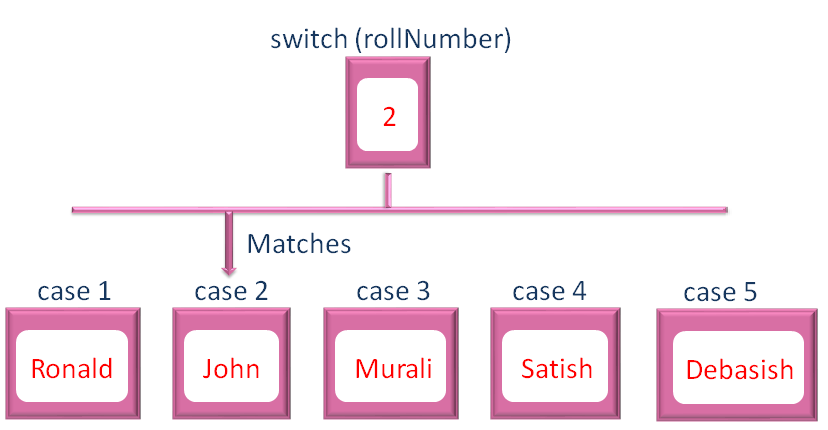
And for every case, it checks for the rollNumber(2 in this case as rollNumber=2).
When it finds a match in case 2.
case 2:
	System.Console.WriteLine("John");
	break;
It print "John" and comes out of the switch statement as we have specified a break statement.
switch(expression/variable) {
	case value1:
		// code for value1
	break;
	case value2:
		// code for value2
	break;
	default:
		// code for default block
	break;
}The default block is also an optional block,
default:
	System.Console.WriteLine("The student does not exist.");
	break;
The default block is only executed none of the cases matches. And is exactly same as,
else {
	System.Console.WriteLine("The student does not exist.");
}
For the if -- else -- if code.
public class MyApplication
{
    public static void Main(string[] args)
    {
        int rollNumber = 10;

        switch (rollNumber)
        {
            case 1:
                System.Console.WriteLine("Ronald");
                break;
            case 2:
                System.Console.WriteLine("John");
                break;
            case 3:
                System.Console.WriteLine("Murali");
                break;
            case 4:
                System.Console.WriteLine("Satish");
                break;
            case 5:
                System.Console.WriteLine("Debasish");
                break;
            default:
                System.Console.WriteLine("The student does not exist.");
                break;
        }
    }
}
In the above code, we are checking for the student whose roll number is 10. And since roll number 10 does not exist, the default block is executed.